 Explainers
What Is the Milky Way Galaxy? Everything You Need to Know
We live inside a galaxy so large that no one can step back and photograph it in a single frame. That is the central challenge of Milky Way astronomy: …
Read more
It is one of astronomy’s most misunderstood terms: a light-year is not a measure of time, but of distance. The name invites confusion, yet the idea is beautifully simple. A light-year is the distance light travels in one year through a vacuum, and because light moves at about 300,000 kilometres per second, that works out to roughly 9.46 trillion kilometres, or about 5.88 trillion miles.
Astronomers use light-years because the universe is too vast for ordinary units to stay useful for long. Saying a nearby star is tens of trillions of kilometres away is technically correct, but hardly intuitive. Light-years turn those enormous figures into something more manageable, especially once we move beyond the Solar System.
And this is where the concept becomes truly thrilling. Because light takes time to travel, looking deeper into space also means looking further into the past. So when we gaze at a star or galaxy, are we seeing it as it is now? Not exactly. We are seeing it as it was when its light began the journey to Earth.
Within the Solar System, astronomers often use the astronomical unit, or AU, which is based on the average distance between Earth and the Sun. But for stars and galaxies, even that quickly becomes unwieldy. One light-year equals about 63,241 AU, which gives a sense of how rapidly cosmic distances escalate.
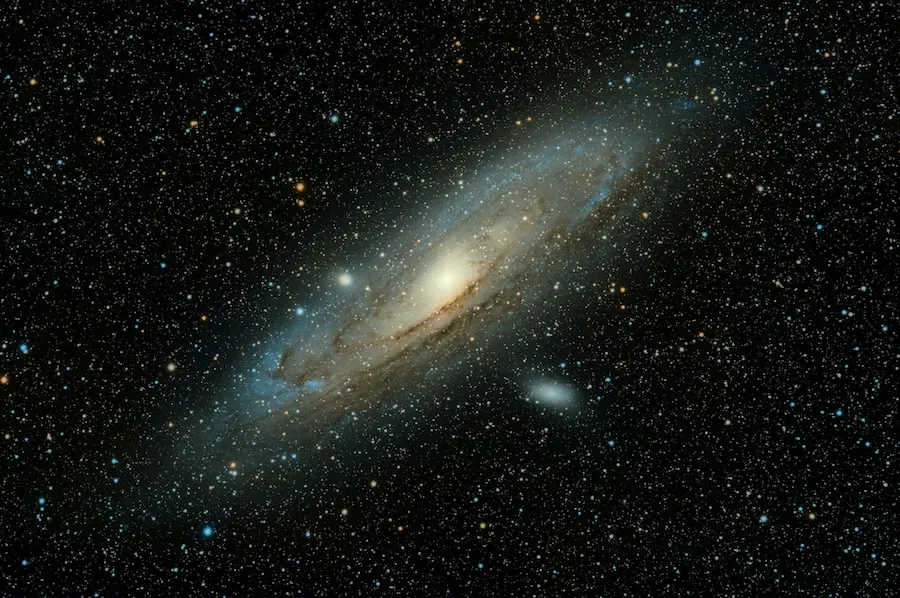
Another common unit is the parsec, widely used by professional astronomers. A parsec is defined through stellar parallax, and 1 light-year is about 0.3066 parsec. Put the other way round, about 3.26 light-years make one parsec. Light-years, though, remain the more intuitive shorthand for explaining the scale of the universe to general audiences.
The usefulness of the unit becomes obvious with real examples. The Sun is around 93 million miles from Earth, so its light reaches us in about 8.3 minutes. That is close enough to describe in light-minutes. But the next closest star, Proxima Centauri, is about 4.24 light-years away. At that point, the language of kilometres begins to lose all meaning for everyday readers.
| Object or scale | Approximate distance | What that means |
|---|---|---|
| Sun | 8.3 light-minutes | We see it as it was 8.3 minutes ago |
| Proxima Centauri | 4.24 light-years | Its light left more than four years ago |
| Orion Nebula | About 1,300 light-years | We see a star-forming region from 1,300 years in the past |
| Milky Way diameter | About 100,000 light-years | A reminder of our galaxy’s immense span |
| Andromeda Galaxy | About 2.5 million light-years | Its light began travelling long before humans existed in current form |
This is the part that gives the light-year its real emotional power. Although it measures distance, it also tells us how old the light is when it reaches us. The farther away an object lies, the older the view we get.
Take the Sun again: we never see it in real time, only with an 8.3-minute delay. That lag is tiny on human scales, but the same principle stretches across the cosmos. Proxima Centauri appears to us as it was more than four years ago. The Orion Nebula, around 1,300 light-years away, is seen as it was when that light first set out towards Earth in the early Middle Ages. And the Andromeda Galaxy arrives in our telescopes from 2.5 million years in the past.
With powerful observatories, the effect becomes extraordinary. The NASA/ESA Hubble Space Telescope observed the galaxy GN-z11 at a distance of about 13.4 billion light-years. That means its light shows the galaxy as it existed 13.4 billion years ago, only about 400 million years after the big bang. In other words, the deeper Hubble looked, the closer astronomy came to the dawn of galaxies themselves.
This is why space telescopes do much more than take dramatic pictures. They act as time machines in the only sense physics allows: by collecting ancient light.
For all its elegance, the light-year is still a practical shorthand rather than the final word on cosmic distance. Astronomers know that the universe is expanding, and that there are several ways to define how far away something really is. Depending on the context, scientists may distinguish between the distance an object was when it emitted its light and the distance it would have now.
That complexity matters in research, but it does not make the light-year less useful. If anything, it shows why the unit endures. It gives us an intuitive yardstick for a universe that otherwise slips beyond comprehension.
And perhaps that is the most remarkable thing about it. A light-year begins as a neat conversion in physics, then opens into something much larger: a way of understanding why the night sky is also a record of history. Every star overhead, every hazy nebula, every faint spiral galaxy is sending a message across distance and time together. Once you grasp that, the cosmos feels less like a silent backdrop and more like an archive written in light.
ExplainersWe live inside a galaxy so large that no one can step back and photograph it in a single frame. That is the central challenge of Milky Way astronomy: …
Read more Explainers
Earth’s spin feels so constant that it is easy to treat it as background scenery rather than one of the defining facts of our planet. Yet the ground b…
Read more Explainers
Astronauts aboard the International Space Station seem to drift effortlessly, as if gravity has somehow been switched off. It is one of the most persi…
Read more