 Astronomy
Neptune’s Moon Nereid May Be a Lost World Survivor
Neptune’s strange moon system may have just become even more fascinating. A new peer-reviewed study published on 20 May in Science Advances argues tha…
Read more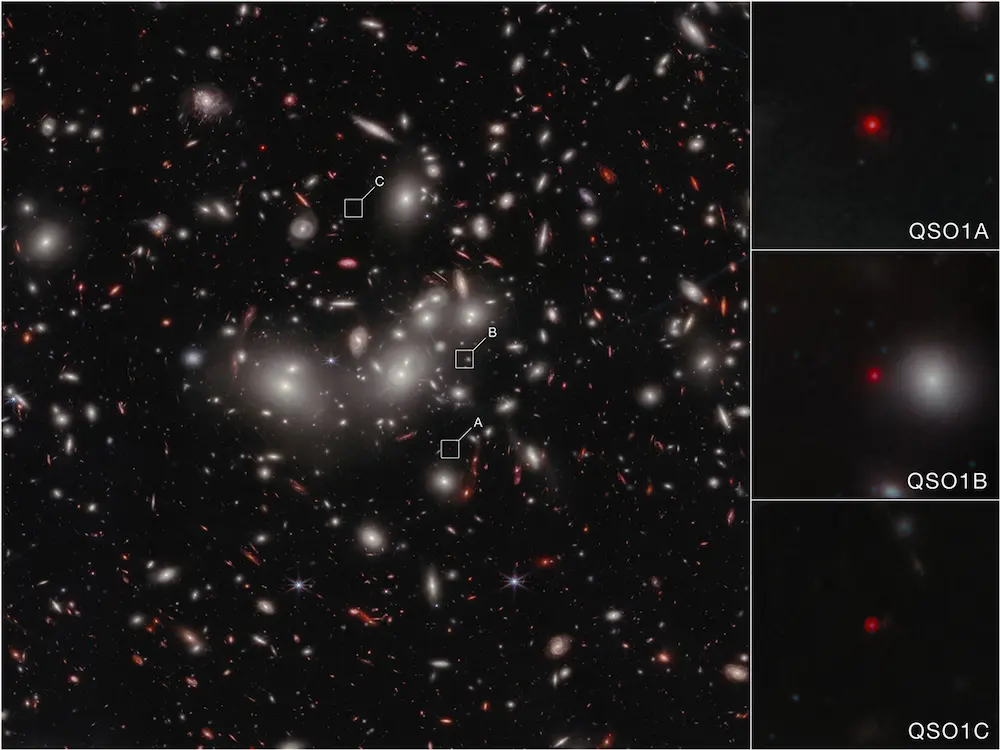
NASA’s James Webb Space Telescope has delivered one of those results that makes the early universe feel even stranger than expected. Astronomers studying a compact object known as Abell2744-QSO1, one of Webb’s so-called Little Red Dots, found evidence for a supermassive black hole that appears to have outgrown — and perhaps even predated — the galaxy around it.
For anyone wondering what that really means, the short version is this: Webb saw an object from just 700 million years after the big bang whose mass seems to be dominated by a black hole, not by stars. That sharply departs from the pattern seen in nearby galaxies, where central black holes are massive but still only a tiny fraction of the total system. Here, the black hole appears to be the main event.
The discovery centres on QSO1, a tiny, intensely red source magnified by gravitational lensing from the galaxy cluster Abell 2744, also called Pandora’s Cluster. The lensing effect made the object easier to study and even produced three separate images of it on the sky. Webb’s observations suggest QSO1 is only about 1,300 light-years across, yet hosts a black hole weighing roughly 50 million times the mass of the Sun. That is extraordinary on its own. More startling still, the black hole seems to make up at least two-thirds of the object’s total mass.
So which came first in the young cosmos: the galaxy or the black hole? In this case, the answer may not be the one astronomers long assumed.

The most important advance here is not simply that Webb found another early black hole, but that it enabled a far more direct mass measurement than earlier estimates. Previous measurements for similar ancient systems often relied on indirect assumptions based on black holes in the modern universe. That left room for doubt, especially because the early cosmos was a much messier place.
Using the integral field unit on Webb’s NIRSpec instrument, researchers mapped the motion of hydrogen gas around QSO1’s centre. One side of the gas appeared shifted towards blue wavelengths, the other towards red, revealing rotation. When the team plotted velocity against distance, the gas followed Keplerian motion — the same gravity-governed behaviour seen when planets orbit the Sun. In other words, the gas looked as though it was circling a compact, dominant central mass.
That mattered because a more spread-out mass distribution, such as a star-rich galaxy, would not produce such a clean rotational pattern. The result let the team calculate the central object’s mass directly, pointing to a black hole of around 50 million solar masses.
| QSO1 at a glance | Observed value |
|---|---|
| Cosmic age when seen | About 700 million years after the big bang |
| Object type | Little Red Dot |
| Estimated size | About 1,300 light-years across |
| Black hole mass | Roughly 50 million Suns |
| Share of total mass in black hole | At least two-thirds |
| Special advantage for study | Magnified and triply imaged by gravitational lensing |
The chemical makeup of the gas reinforced the picture. Webb found that QSO1 is composed almost entirely of hydrogen and helium, with very little oxygen or other heavier elements. Its metallicity is less than 0.5% of the Sun’s, making it one of the most pristine galactic environments measured. That is not what astronomers would expect from a mature, star-packed galaxy, because generations of stars usually enrich their surroundings with heavier elements.
The implication is not necessarily that no galaxy exists at all, but that any host is faint, immature or overwhelmed by the black hole’s presence. That is why some researchers have described QSO1 as a “naked” supermassive black hole: not truly isolated, but lacking the substantial stellar body normally expected around such an enormous object.
This is where the result starts to press on standard ideas of cosmic history. In the nearby universe, supermassive black holes and galaxies appear to grow together. Here, the balance looks inverted. The black hole seems to have raced ahead while star formation lagged behind. That strongly disfavours a slow build-up from ordinary stellar-mass black holes merging over time, because there simply does not seem to be enough stellar material around QSO1 to support that pathway.
Instead, the leading possibilities are more exotic. One is a direct-collapse black hole, formed when a giant gas cloud collapsed without first making stars. Another is a primordial black hole, a hypothetical object born in the first second after the big bang. The new data do not settle that question, but they do suggest the black hole was “born big” rather than assembled gradually from modest beginnings.
Outside experts have also stressed some caution. The measurement has been described as brave and technically demanding, and some astronomers want independent confirmation before treating it as definitive. That is a sensible note of restraint. Webb has revealed a remarkable case, but one case is not yet a census of the early universe.

Even with that caution, QSO1 now stands as one of the clearest signs that some supermassive black holes in the young universe may have formed astonishingly early and grown with startling speed. If Little Red Dots like this turn out to be common, astronomers may need to rethink the timeline of how the first large structures emerged after the big bang.
That would not mean everything we thought we knew was wrong. It would mean the early universe allowed more than one route to building cosmic structure, with some black holes taking the lead and galaxies catching up later. In that picture, the familiar black hole-galaxy partnership still exists, but its opening act was far less orderly than expected.
Researchers are already analysing similar Webb targets to see whether QSO1 is an outlier or part of a broader population. That next step matters enormously. A single unusual object can intrigue; a class of them can reshape theory.
For now, Webb has done what great observatories do best: it has taken a long-standing question and made it sharper, stranger and far more compelling. Out there in the deep red light of cosmic dawn, a black hole may have started building its empire before its galaxy had properly arrived.
AstronomyNeptune’s strange moon system may have just become even more fascinating. A new peer-reviewed study published on 20 May in Science Advances argues tha…
Read more Astronomy
The search for the universe’s first stars has always been one of astronomy’s most tantalising pursuits. Now the James Webb Space Telescope has pushed …
Read more Astronomy
Look up on a clear night and the puzzle seems almost too simple: if the universe contains staggering numbers of stars and galaxies, why is the sky mos…
Read more