 News
NewsNorthern Lights Alert Upgraded Across 23 States
The National Oceanic and Atmospheric Administration’s Space Weather Prediction Center upgraded its aurora outlook for Thursday, 4 June into Friday, 5 …
Read more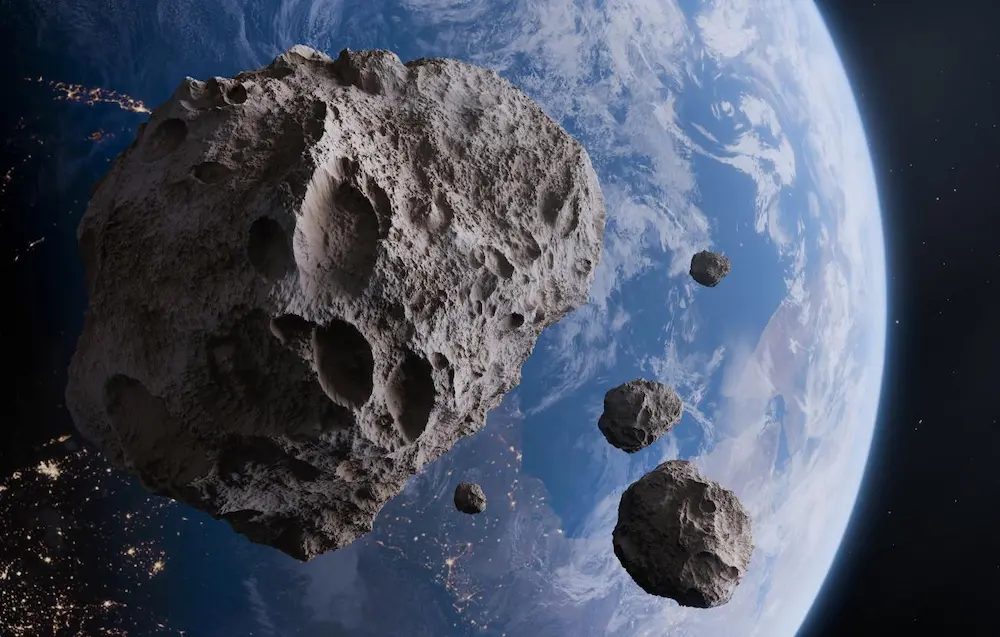
Asteroid 2026 JH2 made a notably close but entirely safe pass by Earth on 18 May, giving skywatchers a vivid reminder of how busy our cosmic neighbourhood really is. If you saw dramatic headlines about a “blue whale-sized” asteroid skimming past the planet, the essential point is simpler and far less alarming: this was a routine near-Earth asteroid flyby, closely tracked by astronomers and posing no threat to Earth or the moon.
The object was discovered on 10 May by the Mount Lemmon Survey in Arizona, so its rapid rise into the news cycle made sense. Freshly found asteroids that pass relatively nearby always attract attention, especially when the numbers sound startling. Yet in space, “close” has its own scale. At its nearest, 2026 JH2 came within 56,628 miles (91,135 kilometres) of Earth at 21:23 GMT on 18 May, around 24% of the average Earth-moon distance. That is close in astronomical terms, certainly, but still comfortably distant in practical ones.
Observers were also able to follow the event through a live broadcast from the Virtual Telescope Project in Italy, weather permitting. Through those telescopes, the asteroid was expected to appear not as a dramatic rocky world, but as a sharp point of light racing across the background stars. And really, what better illustration is there of planetary defence in action than watching a newly discovered object be tracked so precisely within days?
2026 JH2 is classified as a near-Earth object, or NEO, because its orbit brings it relatively close to the orbit of our planet. More specifically, it is an Apollo-type NEO, a group whose members have semi-major axes larger than Earth’s and perihelia under 1.017 astronomical units. In other words, its path around the sun crosses into Earth’s orbital region, which is why astronomers pay attention to objects like this in the first place.
Its size was estimated from its brightness rather than directly measured, which is standard practice for small asteroids. The cited range was between 52 and 114 feet (16-35 metres), with comparisons in coverage ranging from Chicago’s Cloud Gate sculpture to an adult blue whale. Those metaphors are useful for giving a sense of scale, but they come with uncertainty because brightness depends partly on reflectivity as well as true size.
| Asteroid | Estimated size | Closest approach | Relative speed |
|---|---|---|---|
| 2026 JH2 | 52-114 ft (16-35 m) | 56,628 miles (91,135 km) | 19,417 mph (31,248 km/h) |
| Average moon distance | — | About 4 times farther away | — |
During closest approach, the asteroid was travelling at 19,417 mph (31,248 km/h) relative to Earth. That speed sounds immense, and it is, but it is also typical of the high-velocity choreography of the inner solar system.
The most useful thing readers want to know in stories like this is also the most straightforward: was there any impact risk? According to the cited coverage, the answer was no. 2026 JH2 was not considered a threat during this encounter, despite some overheated language often used around close approaches.
That distinction matters because there are tens of thousands of tracked near-Earth objects, and most are of no particular concern. Astronomers monitor them precisely so that a dramatic-sounding flyby does not have to become a mystery. This one, while unusually close compared with many upcoming passes, was still part of a broader pattern. Small asteroids pass near Earth regularly, and some have come even closer. The point is not that 2026 JH2 was extraordinary in danger, but that it was an excellent example of detection and orbit tracking working exactly as intended.
The asteroid’s passage also underscored how misleading intuition can be in space. A quarter of the Earth-moon distance feels uncomfortably near in a headline, yet the moon itself is already our closest major celestial neighbour by far. A gap of more than 56,000 miles remains a substantial buffer.
For anyone hoping to see 2026 JH2, the most practical option was the free Virtual Telescope Project YouTube livestream, which began at 19:45 GMT on 18 May. The timing placed observations close to the asteroid’s minimum distance and near peak brightness, around magnitude 11.5, before it dropped below the horizon from the project’s site in Manciano, Italy.
That brightness meant it was not a naked-eye object. Instead, viewers either needed a telescope or could rely on the livestream’s robotic instruments. The visual payoff was subtle but wonderful in its own way: a pinpoint asteroid held steady by the telescope’s tracking, while the stars stretched into lines behind it.
Now that it has passed, 2026 JH2 is heading away on a 3.8-year journey that will take it out towards the vicinity of Jupiter’s orbit before it loops back sunward on an elongated path. Its next close approach to Earth is not expected until 2060, when it will pass at 17 times the Earth-moon distance.
So the May flyby has already come and gone, leaving behind no damage, no near miss in the cinematic sense, and no reason for concern. What it did leave us with is something arguably better: a crisp demonstration that the solar system is dynamic, crowded and trackable, and that even a newly discovered asteroid can be turned from a source of anxiety into an occasion for clear science and a little awe.
NewsThe National Oceanic and Atmospheric Administration’s Space Weather Prediction Center upgraded its aurora outlook for Thursday, 4 June into Friday, 5 …
Read more News
NewsNASA’s James Webb Space Telescope has captured something remarkably rare: a detailed chemical fingerprint from an object that came from beyond our Sol…
Read more News
NewsTwo Roscosmos cosmonauts stepped back inside the International Space Station on 27 May 2026 after a tightly choreographed spacewalk that blended orbit…
Read more