 Science
Solar Wind Explained: The Sun’s Invisible Space Weather
The solar wind is the Sun’s constant outflow of electrically charged particles, an invisible stream that fills the solar system every day. For anyone …
Read more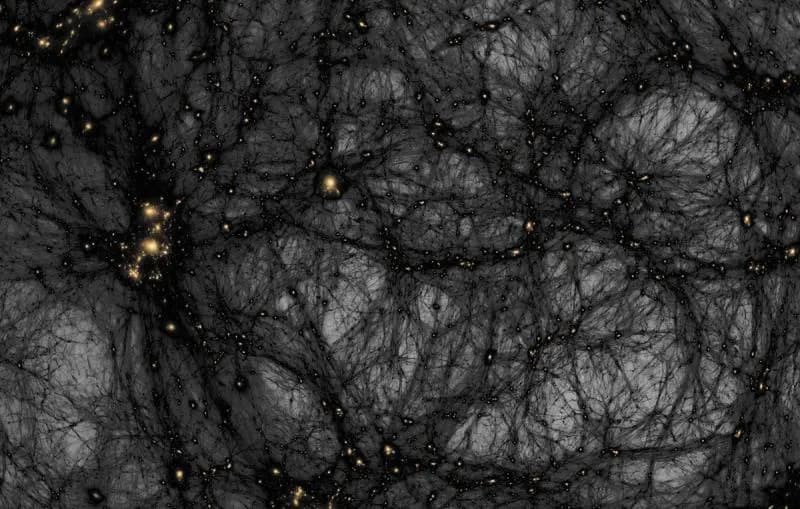
Dark matter is one of astronomy’s strangest facts: the Universe appears to be built on something we cannot see. It does not shine, reflect or absorb light, yet its gravity helps hold galaxies together and shapes the vast cosmic web stretching across space. For anyone asking what dark matter actually is, the most honest answer is that astronomers know how it behaves far better than what it is made of.
The broad picture is now remarkably clear. Dark matter is not ordinary matter made of stars, gas, dust or planets, and it is not the familiar atomic material that makes up people, worlds and nebulae. Instead, it is thought to be a non-luminous form of matter that accounts for about 27% of the Universe, while ordinary matter is only about 5%. The rest is dark energy. That balance alone hints at how profoundly incomplete our everyday view of the cosmos really is.
And yet the case for dark matter did not begin with exotic particles. It began with a mismatch between what astronomers could see and how the Universe actually moved.
The evidence trail starts with motion. In galaxy clusters, Fritz Zwicky found that galaxies were moving too quickly to be held together by visible matter alone. Later, Vera Rubin’s work on galaxy rotation curves sharpened the mystery: stars far from galactic centres were orbiting much faster than expected. If only visible matter were present, those outer stars should have drifted away. Instead, galaxies seemed embedded in enormous haloes — vast, roughly spherical regions of unseen mass surrounding the bright galactic disc.

Then came one of the most powerful tools in modern cosmology: gravitational lensing. Because gravity bends light, astronomers can infer hidden mass from the way background galaxies appear distorted. In its subtle form, called weak lensing, countless tiny shape changes across the sky can be combined into a kind of shadow map of matter, including the invisible portion. In more dramatic cases, massive objects create stretched arcs and multiple images of distant galaxies.
Perhaps the most striking example is the Bullet Cluster, where the hot gas — ordinary matter seen in X-rays — is offset from the main mass traced through lensing. That separation is difficult to explain if the effect comes only from changing gravity. It points instead to an unseen component that passed through the collision differently from the hot gas.
| Evidence | What astronomers observe | What it suggests |
|---|---|---|
| Galaxy rotation curves | Outer stars orbit too fast | Galaxies sit inside dark matter haloes |
| Galaxy clusters | Clusters contain more gravity than visible matter allows | Large reservoirs of unseen mass exist |
| Gravitational lensing | Light from distant galaxies is distorted | Dark matter can be mapped indirectly |
| Cosmic microwave background | Early-Universe patterns require extra matter | Dark matter was present very early on |
| Large-scale structure | Galaxies form in a web-like pattern | Dark matter acts as cosmic scaffolding |
The cosmic microwave background adds another layer. Tiny fluctuations in this afterglow of the Big Bang preserve a record of the young Universe, and their pattern only makes sense if dark matter was already present, helping ordinary matter gather into denser regions. That same ingredient is needed in simulations that reproduce the growth of galaxies and clusters across cosmic time. So the dark matter case is not built on one clue, but on many, all pointing in the same direction.
If dark matter cannot be photographed directly, can it still be charted? Absolutely — and this is where modern space astronomy becomes especially exciting. ESA’s Euclid mission was designed to explore the composition and evolution of the dark Universe by mapping the large-scale structure of the cosmos across space and time. Launched on 1 July 2023 and operating at the Sun-Earth Lagrange point 2, about 1.5 million km from Earth, Euclid is observing billions of galaxies out to 10 billion light-years across more than a third of the sky.
That matters because weak lensing is statistical. The more galaxies a mission can measure, the better astronomers can trace where matter lies and how it has clumped over billions of years. Euclid’s great strength is that it is not merely taking pretty pictures, although its images are spectacular; it is building a three-dimensional atlas of the Universe. Those maps should help researchers test how structure grew, how gravity behaved over cosmic history, and how dark matter and dark energy shaped the result.
This is where Hubble’s legacy also matters. The Hubble Space Telescope helped transform cosmology by revealing dark energy and by providing deep, sharp views of galaxies and lensing systems. Euclid now extends that story across far wider cosmic real estate. One offers exquisite detail; the other, sweeping statistical reach. Together they show how astronomy often advances: not through a single decisive image, but through layers of evidence from complementary observatories.
For all that observational success, the identity of dark matter remains unknown. Leading candidates include WIMPs, or weakly interacting massive particles, which would have mass and feel gravity but scarcely interact with ordinary matter; axions, extremely light particles that could fill space as a cold invisible background; and sterile neutrinos, an even more elusive hypothetical relative of known neutrinos. There are also more speculative possibilities, including primordial black holes, though these sit further from the mainstream picture.
Scientists are searching on several fronts. Underground detectors such as LUX-ZEPLIN and XENONnT are built to catch the faintest possible interaction between dark matter and normal matter. The Large Hadron Collider looks for missing energy signatures that could hint at dark matter particles produced in collisions. Astronomers also search the sky for indirect signs, such as gamma rays that might arise if dark matter particles annihilate one another.
Alternative ideas do exist, especially modified gravity models such as MOND, which propose that gravity behaves differently on large scales. These can explain some galactic motions, but they have a much harder time accounting for the full combination of evidence from lensing, galaxy clusters and the cosmic microwave background. That is why most researchers still favour dark matter as a real substance rather than a mere tweak to the rules.
So we are left with a wonderful scientific tension. Dark matter is invisible, but not vague; hidden, but measurable. It is the unseen framework beneath galaxies, the mass revealed by warped light, the quiet architect of structure on the largest scales. What is it, really? That question remains open — and missions such as Euclid are bringing us closer to an answer by turning the invisible Universe into something we can finally map.
ScienceThe solar wind is the Sun’s constant outflow of electrically charged particles, an invisible stream that fills the solar system every day. For anyone …
Read more Science
Black holes were once the strangest implication of Albert Einstein’s general theory of relativity: regions of space where gravity becomes so intense t…
Read more