 News
NewsNorthern Lights Alert Upgraded Across 23 States
The National Oceanic and Atmospheric Administration’s Space Weather Prediction Center upgraded its aurora outlook for Thursday, 4 June into Friday, 5 …
Read more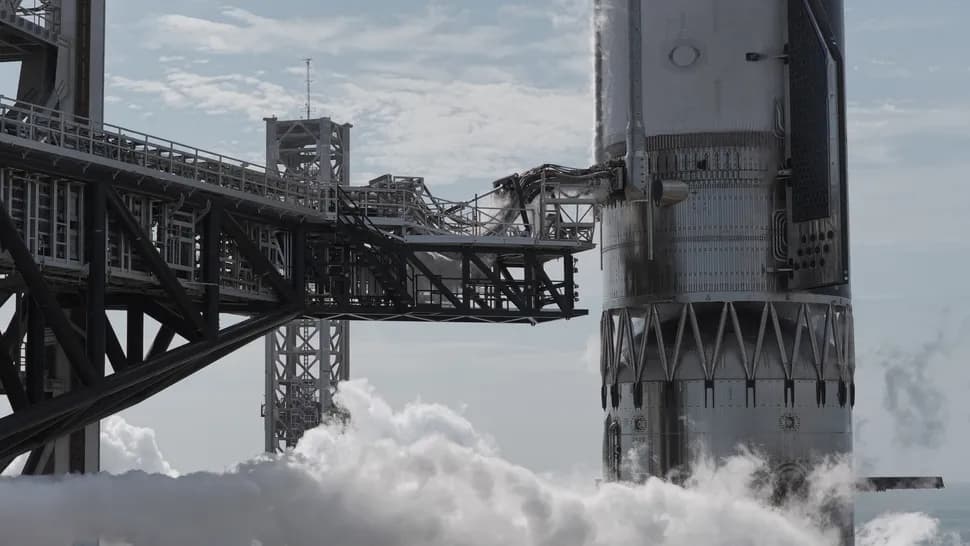
SpaceX is targeting 19 May 2026 for the first launch of Starship Version 3, the newest and largest iteration yet of the company’s giant launch system. Liftoff is scheduled for 6:30 p.m. Eastern, which is 5:30 p.m. local time in Texas. The mission, known as Flight 12, is set to fly from Starbase in South Texas, near Brownsville and Boca Chica.
For anyone trying to understand why this test matters, the answer is fairly direct: Version 3 is the Starship design SpaceX has described as its next real step towards operational use. That includes future satellite deployment missions and the company’s role as a lunar lander provider for NASA’s Artemis programme. In other words, this is not just another launch attempt. It is a first look at hardware SpaceX wants to turn into its production path.
The timing also follows a long gap. SpaceX had not flown Starship since October 2025, taking extra time to work through upgrades, testing and launch pad preparations. A booster originally intended for this flight was also damaged during testing in November, contributing to delays that pushed the debut well beyond earlier expectations.
Version 3 brings substantial revisions to both parts of the vehicle: the Super Heavy booster and the upper-stage Starship spacecraft. Fully stacked, the new rocket stands at about 407 feet, making it roughly four feet taller than the previous version.
SpaceX and reporting from both sources point to one central theme behind the redesign: better performance and faster reusability. The company has upgraded the Raptor engines, and the upper stage has a reworked propulsion system intended to carry more propellant for longer-duration missions. The booster’s landing hardware has also changed: instead of four grid fins, Version 3 uses three larger and stronger fins, each enlarged by 50%.
There is also a major ground-systems angle. Flight 12 will be the first Starship launch from Pad 2 at Starbase, a new launch pad equipped with an upgraded propellant farm with more storage and additional pumps to speed up fuelling. Even the launch tower’s catching arms, the now-famous “chopsticks”, have been shortened so they can move faster while tracking a returning booster.
| Feature | Version 3 detail |
|---|---|
| Launch date | 19 May 2026 |
| Launch time | 6:30 p.m. Eastern / 5:30 p.m. Texas local time |
| Launch site | Starbase, South Texas |
| Height | About 407 feet |
| Booster fins | Three fins, each 50% larger |
| Pad | New Pad 2 with upgraded propellant systems |

SpaceX has been unusually clear about the immediate goal: this mission is primarily about putting the redesigned hardware into the real flight environment for the first time. That sounds modest, but for a test programme like Starship, it is the essential first question. Can the upgraded system survive and perform as expected once it leaves the pad?
The flight profile is suborbital. Unlike some earlier plans that emphasised booster recovery at the launch site, Super Heavy will not attempt a return to the tower on this mission. Instead, it is expected to make a soft splashdown in the Gulf of Mexico. That decision alone says something about priorities: Flight 12 is less about showing off recovery choreography and more about reducing variables while the new design takes its first trip skyward.
The upper stage has a busier test plan. Once in space, Starship is set to deploy 22 mass simulators representing next-generation Starlink satellites. Two of those carry imagery payloads designed to inspect the vehicle’s heat shield, testing techniques SpaceX wants to use later to assess whether the shield is ready for re-entry and eventual returns to the launch site.
SpaceX also plans to relight a single Raptor engine in space, repeating a type of demonstration attempted on earlier flights. During re-entry, the company intends to carry out manoeuvres that deliberately stress the vehicle and simulate the handling needed for future landings. In one especially telling experiment, a single heat-shield tile was intentionally removed before launch so engineers can study how neighbouring tiles behave under aerodynamic load. What better way to learn the limits of a spacecraft than to test them, carefully, on purpose?
SpaceX has tied Version 3 to ambitions that stretch well beyond South Texas. The company sees this as the Starship model for orbital missions, including the deployment of next-generation Starlink satellites. Just as significantly, Starship remains central to NASA’s plans to use a commercially developed Human Landing System for Artemis moon missions.
That does not mean one successful launch suddenly unlocks the Moon. Developmental test campaigns rarely move in straight lines, and both sources frame this as a cautious, high-risk step rather than a finishing milestone. Even so, the strategic weight is obvious. If Version 3 performs well, SpaceX can begin building confidence in the design it wants to reuse frequently and eventually fly in far more demanding roles.

Before settling on the 19 May target, SpaceX carried out a sequence of preflight checks, including static fires of the booster and upper stage in April, followed by wet dress rehearsals at the pad. One rehearsal on 11 May appeared to clear the way for the formal target-date announcement the next day.
The company has also signalled that Starbase is only part of a broader Starship network. SpaceX said it is exploring additional launch locations because its long-term goal is to fly Starship at very high cadence from multiple sites in the United States and beyond. For now, though, all eyes are on Boca Chica. Flight 12 is where Version 3 meets the sky for the first time — and where the next chapter of Starship will finally stop being conceptual and start becoming measurable.
NewsThe National Oceanic and Atmospheric Administration’s Space Weather Prediction Center upgraded its aurora outlook for Thursday, 4 June into Friday, 5 …
Read more News
NewsNASA’s James Webb Space Telescope has captured something remarkably rare: a detailed chemical fingerprint from an object that came from beyond our Sol…
Read more News
NewsTwo Roscosmos cosmonauts stepped back inside the International Space Station on 27 May 2026 after a tightly choreographed spacewalk that blended orbit…
Read more