 News
NewsNorthern Lights Alert Upgraded Across 23 States
The National Oceanic and Atmospheric Administration’s Space Weather Prediction Center upgraded its aurora outlook for Thursday, 4 June into Friday, 5 …
Read more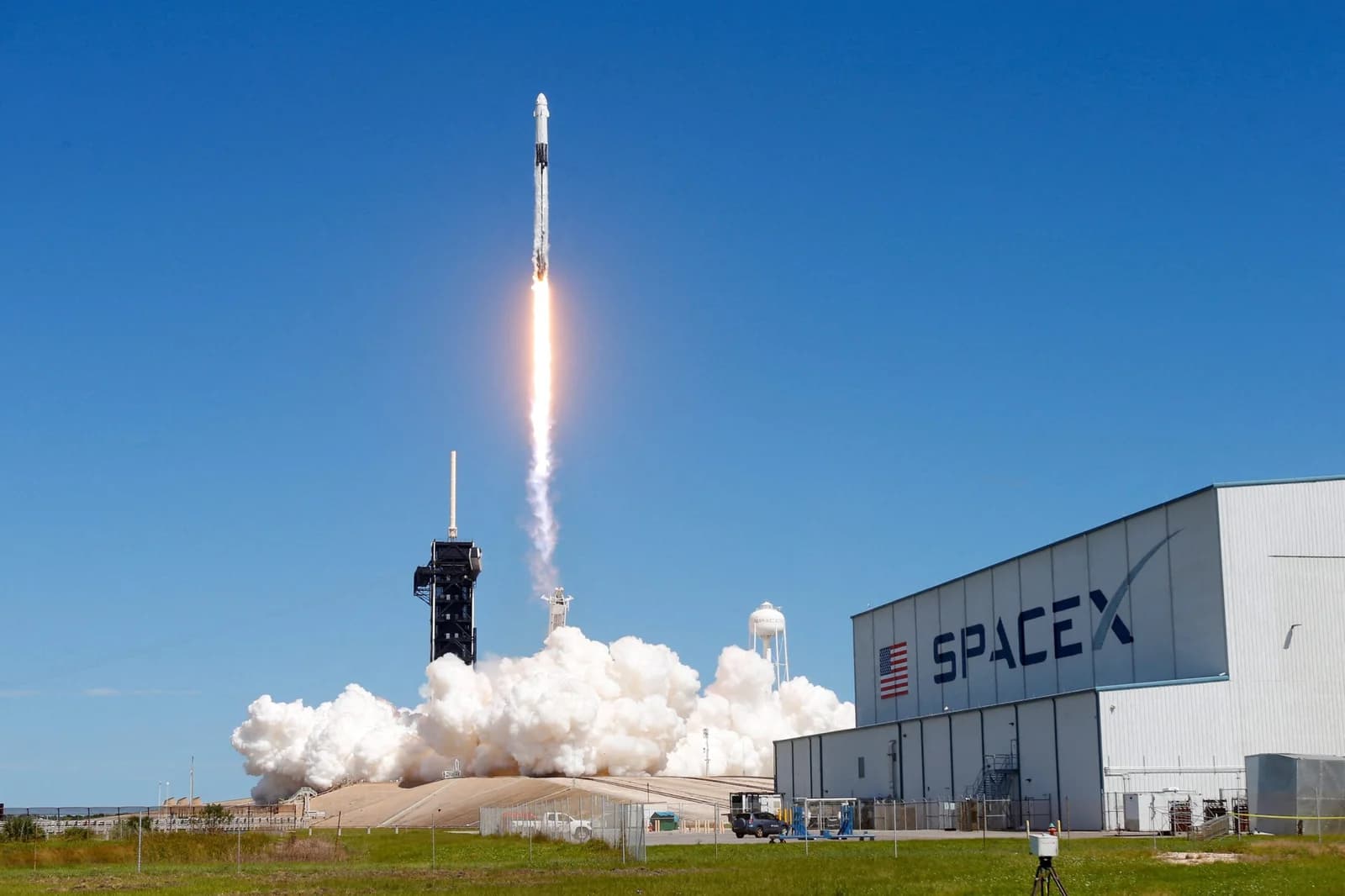
SpaceX has launched another classified mission for the United States, sending the NROL-172 payload to orbit aboard a Falcon 9 rocket from California. Liftoff took place on May 11, 2026, at 10:13 p.m. EDT from Vandenberg Space Force Base, or 7:13 p.m. local time on the foggy Central Coast.
For anyone searching for what happened and why it matters, the essentials are surprisingly clear despite the secrecy. The mission flew for the U.S. National Reconnaissance Office, the agency that operates America’s fleet of spy satellites, and it marked the 13th launch supporting the organisation’s new “proliferated architecture” reconnaissance network. That phrase matters more than almost any missing technical detail: it signals a deliberate shift towards a larger, more distributed system of satellites rather than relying only on a smaller number of exquisite assets.
As so often with NRO flights, however, the most tantalising questions remain unanswered. How many satellites were on board? What exactly do they do? Which orbit are they heading for? The public record does not say, and that silence is part of the story.
According to the mission details released publicly, the Falcon 9 lifted off successfully from Vandenberg on a mission that SpaceX and the NRO streamed only through the early part of ascent. After launch, the webcast ended at the NRO’s request, a standard move for classified national security flights once the rocket reaches a point where trajectory or deployment information could reveal too much.

The first stage performed its part with familiar precision. It returned to Earth about 8.5 minutes after liftoff, landing on the SpaceX drone ship Of Course I Still Love You in the Pacific Ocean. This was the second flight for that particular booster. The source article did not provide a core number, so there is no need to stretch beyond what was confirmed.
What was confirmed is that the launch appeared to proceed as planned. Publicly, though, that does not extend to payload deployment. On missions like this, even successful insertion is often left unstated in real time.
| NROL-172 mission facts | Details |
|---|---|
| Launch date | May 11, 2026 |
| Launch time | 10:13 p.m. EDT / 7:13 p.m. local / 0213 GMT on May 12 |
| Rocket | SpaceX Falcon 9 |
| Customer | U.S. National Reconnaissance Office |
| Launch site | Vandenberg Space Force Base, California |
| Booster outcome | Landed on Of Course I Still Love You |
| Network context | 13th launch for NRO’s proliferated architecture |
The U.S. National Reconnaissance Office sits at the intersection of spaceflight and intelligence, which means its launches offer just enough visibility to confirm they happened but rarely enough to explain the payloads in operational terms. In the NROL-172 press kit, the agency said it is modernising both its space and ground systems to operate in a more threatening environment, with greater resilience and faster delivery of capability.
That strategy is reflected in the NRO’s own description of the new network: more satellites, large and small, government and commercial, in multiple orbits, producing far more signals and imagery than today’s architecture. There is a subtle but profound change embedded in that wording. Rather than concentrating capability in a handful of spacecraft, the agency is building a broader orbital web that should be harder to disrupt and quicker to replenish.
The satellites in this new architecture have been built by SpaceX and Northrop Grumman. Beyond that, the NRO has not disclosed how many spacecraft launch on each mission, where they operate, or their specific roles. That makes each launch both revealing and frustrating: we learn about tempo, partnerships and strategic direction, but not the payload itself.
NROL-172 was not merely another Falcon 9 launch in a busy manifest. It was also the 55th Falcon 9 mission of 2026, a remarkable figure by any standard, and one that helps explain why the rocket has become so valuable for national security customers. Rapid launch cadence, repeatable operations and booster recovery are no longer side notes; they are part of the service being bought.

That is especially visible at Vandenberg, where every launch for the NRO’s proliferated architecture so far has flown on Falcon 9. The first, NROL-146, launched in May 2024, and the most recent before NROL-172 was NROL-105 in January 2026. The pattern is unmistakable: a secretive reconnaissance network is being assembled not through rare, monumental launches, but through a growing rhythm of comparatively routine missions.
There is another telling statistic in the wider 2026 launch picture. Of SpaceX’s first 55 Falcon 9 missions this year, 44 were devoted to Starlink. That commercial cadence has effectively become the company’s proving ground for reusability and operational speed, and those same strengths now underpin missions for intelligence and defence customers as well.
So while NROL-172’s payload remains hidden, the broader meaning is plain enough. The launch showed a reusable rocket delivering a classified mission on schedule, recovering its booster, and then drawing a curtain over the rest. In modern military spaceflight, that combination of openness and opacity is becoming its own kind of signature.
NewsThe National Oceanic and Atmospheric Administration’s Space Weather Prediction Center upgraded its aurora outlook for Thursday, 4 June into Friday, 5 …
Read more News
NewsNASA’s James Webb Space Telescope has captured something remarkably rare: a detailed chemical fingerprint from an object that came from beyond our Sol…
Read more News
NewsTwo Roscosmos cosmonauts stepped back inside the International Space Station on 27 May 2026 after a tightly choreographed spacewalk that blended orbit…
Read more